
This time, I took my favorite hiking buddy, Hikin' Joyce.

We went up the road that leads to the DWA property. The sign on the gate seems to imply that one can only use the road to get to the PCT, which is not true. Public access on foot is permitted in all of the land that is National Forest land (i.e. public land). The precise legal definition of the public land just north of the DWA property is Township 3 South, Range 3 East, Section 28.

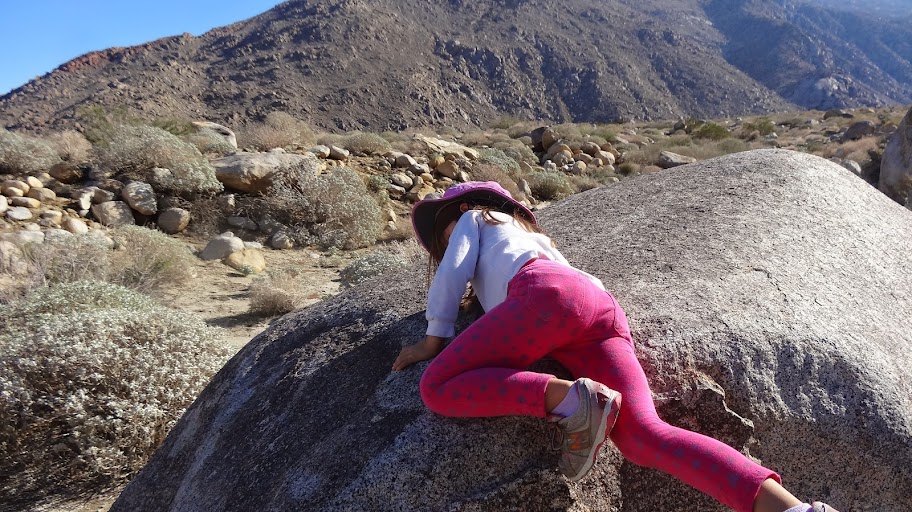
Heading up the road, Joyce unleashed her inner rock climber. Good thing her mother doesn't read this forum or she'd never let me take Joyce out again.



Heading up the road, we met Bob, the security guard, in his truck. Bob was quite cordial. When we started walking up the road past the drinking fountain he warned us that we were approaching private property. I told Bob that we knew where the property line was and I showed him my maps and satellite photos. He let us proceed. We therefore headed into terra incognita, that portion of Section 28 (which, remember, is public land) I had always heard that the DWA was keeping people out of. If the DWA has kept people out of the upper part of Section 28 in the past, I hope that the DWA lease renewal process has made all parties aware that public access on foot is permitted.

Of course we probably don't quite look like Al Qaeda terrorists, so that may have helped.

Further up the road is some interesting stuff like this oak tree which appears to be interior live oak (Quercus winslenzi), which is similar to the coast live oaks which grow near me where I live in Orange County. It was fun to observe the subtle differences.

Heading further up, we saw historic Hicks Cabin. Recall that the Hicks family was instrumental in bringing water out of Snow and Falls Creeks to Palm Springs in the prior century. Hicks cabin is a residence, so out of respect, we did not approach.

At long last, we neared the residence that the DWA maintains in Snow Creek Canyon.

As we approached, who should come out but none other than Warren who is the DWA caretaker (hopefully that's the correct title). Now, I had heard many stories about Warren. I half expected something between Darth Vader and the Gestapo, but in real life Warren was quite personable. We had a nice chat. He even let my daughter play with his dog, Molly. Interestingly, Warren greeted me by name ("Hikin' JIm") as I approached even though we had never met. I had heard that the DWA reads the local forums. It would appear that what I have heard is true.
Now, on my last visit, I had noted that the DWA residence had what appeared to be a fence in front of it. I found this fence interesting because the USGS, USFS, and ESRI topographic maps all show the property line in back of the DWA residence, a discrepancy of about 30 yards. It seemed odd to me that the DWA would build a fence on public land.

Here's an aerial photo. The purple line indicates the property boundary per the USGS, USFS, and ESRI topographic maps.

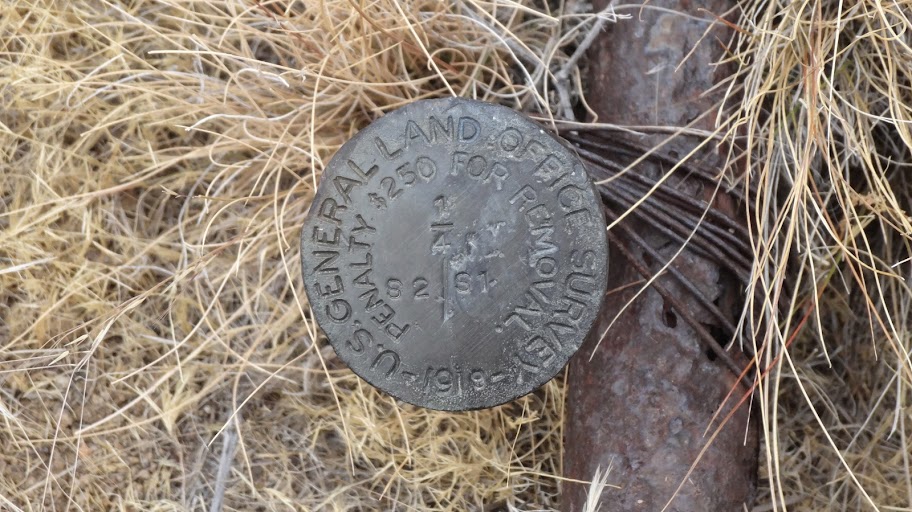
I asked Warren about this. Warren said that the property had been surveyed multiple times and that the fence was in fact on the property line. He said that surveyors had gone up on to the hillsides above Snow Creek Canyon, found the large boulder inscribed with an "+". This inscription was made during the official survey in 1896. Yes, that's 1896 not 1986, in other words, way before GPS, laser sighting equipment, etc. They did everything with surveyor's transits along lines of sight and used physical chains to measure distances, like the way the NFL uses a chain to measure a first down, but survey chains were much longer.
NW S33
3S3E300200 V407 P47 6/3/1896 Pearson 80.00 The point for the section corner 150 feet above gulch falls on flat top of boulder in place 40 feet N. and S. boundary 40 feet E. and W. on which I cut a cross (+) at exact corner point for the corner of sections 28, 29, 32 and 33 marked with 1 notch on the S. and 4 notches on E. sides and raised a mound of stone 4 feet base 2 feet high 4 feet W. of corner.
Well, I was at a bit of a loss here. How come the maps show the boundary 30 yards or so further south? I started to investigate a bit. Notice that the USGS topographic map shows a thin solid line almost exactly where the DWA fence is. This line is the UTM coordinate grid square. The UTM coordinate system breaks the world down into 1 kilometer squares. Land sections are often adjusted for practical reasons. Because of these adjustments, the survey lines don't always line up with "pure" latitudinal lines. In this case, the section boundary is some 30 yards south of the UTM grid line -- exactly the distance the DWA fence appears to be off by.
So, this is just a theory, but it's possible that in the 1896 survey, the boundary markers were incorrectly placed, that they were placed on the UTM grid line and were not placed in accordance with the adjusted section. Subsequent surveys using those markers verified the 1896 property line -- but since the boundary markers were misplaced, the same mistake was repeated, and the UTM line was used not the Section line. As I say, this is just a theory, but it seems no coincidence that the DWA fence lies almost exactly on the UTM grid line.
It would take much more survey work to confirm or refute my theory, survey work that would have to do more than simply rely on the 1896 boundary markers. Again though note that all three of the topo maps of the area show the Section boundary (and thus the DWA property line) as being south of the UTM grid line which places the DWA fence 30 yards into public land.
There are at least two possibilities* here:
1. The topo maps are wrong, and the DWA fence is on the property line.
2. There was some kind of error in the 1896 and/or subsequent surveys, and the DWA fence is incorrectly placed 30 yards north of the property line.
But, let's put it into perspective here. We're talking about a distance on the order of roughly 100 feet. Is there anything in that 100 feet that the public has some great interest in? Is there something in that 100 feet that would cause harm if the public were denied access? Probably not. So whether there is a map error or a survey error, it really doesn't make a material difference, at least not in my eyes. This to me is an interesting question but in a more academic rather than practical sense. At least I've come up with an explanation as to why the maps and the DWA's fence don't seem to line up properly.
All in a day's (map) work,
HJ
*Of course both the topo maps and the survey could be wrong as a third option, but since I'm trying to resolve the discrepancy between the two, I'm making the assumption that at least one is correct.