TR: Folly Peak, Mid-October 2014

General Palm Springs area.

TR: Folly Peak, Mid-October 2014

Postby jfr » Sat Nov 01, 2014 5:50 pm

This TR is a couple of weeks old, but here it is anyway, better late than never (it took me that long to get my photos organized and uploaded):


Vicki and I decided to take one last backpacking trip in the mountains this year, to get in some high-altitude relaxation before the holidays, and also to get in some hiking before the snow starts falling. (Unlike most of the maniacs on this board, we're not real big on being frozen half to death.) :D

First, the backstory: Long ago in June the two of us had great plans for getting in shape for our big summer trek. (Ten days in the North Cascades!) One small part of that greater plan was to backpack up to Little Round Valley via the Fuller Ridge Trail, spend the night, hit Folly Peak and San Jacinto Peak the next day, then stay a second night at LRV, and hike back out. A fun trip! But other things happened, instead. Annoying things that just HAD to be dealt with, and our plans were postponed. Meanwhile, the rest of our summer weekends had already been allocated. True, we had lots of fun on those other hikes, but Folly Peak remained unconquered.

What with one thing and another, we couldn't get away until mid-October. And we also got lazy. We decided to take the tram and camp in Tamarack Valley. Our big trek back in August was finished and we no longer needed to get in shape! And that's why we decided to take life extra easy this time, hiking in on a Friday, day-hiking to Folly Peak on Saturday, and eventually dragging our still-out-of-shape butts back to the tram on Sunday.

It sure sounded easy when I got the permit. But soon enough I read on the board that even the Round Valley Spring had dried out! OK, we said. We'll hike in, set up camp, then hike on back to Long Valley for more water. Three trips total, not one. With all this extra hiking the Fuller Ridge Trail started sounding a whole lot better, but it was far too late to change the permit.

So, we got up relatively late, drove up from San Diego, had breakfast in town, and took the first tram up at 10am on Friday the 17th. There was a sign at the lower tram station warning about the lack of water in Round Valley, but we already knew that. We headed for the Ranger Station and checked in, and discovered that other backpackers hadn't seen the sign. They weren't happy. They should've been reading this board! The ranger told us that we could get extra water from their hose out back, and on we hiked, heading up the Sid Davis Trail to Tamarack Valley.


Image
Willows showing their fall colors in Long Valley.


Image
I'm glad someone finally chopped through this annoying deadfall on the Sid Davis Trail! Thank you!


Image
The Andesite campsite in Tamarack Valley, not far from Cornell Peak.


Image
Unfinished outhouses without doors in Round Valley. They were exactly like this LAST October when we had the Hikin' Fools Potluck! Weren't those CCC folks up there working all summer long? What were they doing? Well, maybe they were busy doing more important things.


Image
Indeed, it's true: Round Valley Spring has run dry this year. :(


Image
Water hose at the ranger station in Long Valley. We filled up 2 extra gallons from this hose and carried them back to camp. But WE MADE A BIG MISTAKE: We filled them directly from the hose, and not the spigot! It wasn't until we got to camp that we realized that all the water tasted like rubber hose! Bleah! It was drinkable, I'll grant you that, and I've drunk worse-tasting water than that on the trail, but why didn't I think to simply unscrew the darn hose first? Arrghhh!


Saturday morning we slept in a bit. It was chilly and we weren't in too big a rush. We stayed snug in our sleeping bag, waiting for the sun to actually strike the tent before getting up to make some breakfast. Then we got ready to hike.

Our plan was to strike for the old unmaintained Tamarack Trail, our shortcut to the summit.


Image
Looking across [Sensitive Area] toward Cornell Peak from the old Tamarack Trail.


Image
Hiking along the overgrown and unmaintained Tamarack Valley Trail. Somebody needs to get some loppers up here! :)


Image
Panorama view south from high on the San Jacinto Peak Trail beyond the Miller Saddle switchback.


Image
We hung a left toward Little Round Valley at the trail junction just below San Jacinto Peak.


Call us foolish all you want, but we were heading for folly!


We took the Deer Springs Trail down toward Little Round Valley, but only until the first switchback, at which point we headed cross-country, trying to maintain elevation around the mountain.


Image
Side-hilling toward Folly Peak after descending part way down the Deer Springs Trail. It was pretty easy hiking, no cliffs and minimal scrambling required. Class 2, maybe a touch of Class 3, depending on your route.


Image
San Jacinto Peak and the Folly Peak summit register.


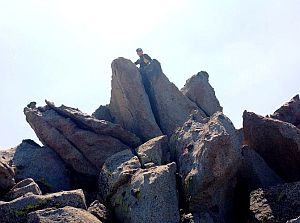
Folly was a really cool peak, lots of big granite slabs and boulders. I liked it. A bit like Marion but nowhere near the exposure. And great views all around, of course, especially to the north and west.


Image
Panorama view northwest to Fuller Ridge, Mount Baldy, and San Gorgonio Mountain from the Folly Peak Summit.


Image
Pines in the sun on our way back to the trail from Folly Peak. It was a great day to be hiking!


Image
The only flower we saw the entire trip, blooming in October near our campsite in Tamarack Valley.


Image
We made it back to our tent in Tamarack Valley, and decided to hike out early.

Vicki hadn't been feeling all that great this trip; she'd come down with some sort of head cold, so we packed everything as fast as possible, and headed back to the tram.


Image
We carried our two gallons of extra water back to Round Valley to give to other hikers, so that all of our work the day before wouldn't go to waste. And we found several folks who were thankful, and perfectly happy to drink that nasty "hose" water. Hooray!


We made it back to the tram before sunset, ate dinner in Palm Springs, and arrived at home by 10pm. We decided that the mountain would still be there for us in the Spring, and that it was perfectly OK if it began snowing right away, so that all the maniacs on the board could start Winter Mountaineering immediately! :D


Image
A Google Earth screenshot of our track showing the nearly level path we took sidehilling around the mountain to Folly Peak.

Image
Topo map showing our GPS tracks.

The rest of my photos are on my Flickr Page: https://www.flickr.com/photos/_jfr_/set ... 747761904/

Happy Hiking!
My (collected) trip reports: http://hikingtales.com/
User avatar
jfr
 
Posts: 145
Joined: Sun Jul 12, 2009 11:10 am
Location: 32N 117W

Re: TR: Folly Peak, Mid-October 2014

Postby tekewin » Mon Nov 03, 2014 5:29 pm

Awesome photos!
User avatar
tekewin
 
Posts: 95
Joined: Mon Apr 01, 2013 5:19 pm
Location: United States

Re: TR: Folly Peak, Mid-October 2014

Postby Hikin_Jim » Mon Nov 10, 2014 11:20 pm

A really great hike and a great set of photos. And now you know the "secret" of Folly Peak: The fabulous angle on San Jacinto Peak.
Image

Personally, I like to hit San Jacinto first and then head over to Folly. The class 2 descent down the west ridge of San Jacinto is a really a lot of fun.

Now, do my eyes deceive me or is someone wearing a new backpack?
Image

HJ
Backpacking stove reviews and information:  Adventures In Stoving
Personal hiking blog: Hikin' Jim's Blog
User avatar
Hikin_Jim
 
Posts: 4958
Joined: Mon Oct 30, 2006 9:12 pm
Location: Orange County, CA

Re: TR: Folly Peak, Mid-October 2014

Postby jfr » Tue Nov 11, 2014 9:19 pm

Hikin_Jim wrote:Now, do my eyes deceive me or is someone wearing a new backpack?

Yes, indeed! That's an Osprey Viva 50 pack (3.5 lb), which is about half the weight of her old external frame pack. Unseen is the other newer, lighter gear, like the North Face Thermoball Hoodie Jacket and the Western Mountaineering Flash Pants (850 down - super warm and light), both of which saved her from carrying several pounds of bulky heavy fleece (jacket and pants). Basically, we followed your advice from when we hiked last October, to upgrade the pack and ditch the fleece. Thanks, Jim! Got any other good ideas?
My (collected) trip reports: http://hikingtales.com/
User avatar
jfr
 
Posts: 145
Joined: Sun Jul 12, 2009 11:10 am
Location: 32N 117W

Re: TR: Folly Peak, Mid-October 2014

Postby Hikin_Jim » Wed Nov 12, 2014 6:52 pm

jfr wrote:That's an Osprey Viva 50 pack (3.5 lb), which is about half the weight of her old external frame pack. Unseen is the other newer, lighter gear, like the North Face Thermoball Hoodie Jacket and the Western Mountaineering Flash Pants (850 down - super warm and light), both of which saved her from carrying several pounds of bulky heavy fleece (jacket and pants). Basically, we followed your advice from when we hiked last October, to upgrade the pack and ditch the fleece. Thanks, Jim!
Nice! :) Yeah 3.5 lbs is lot better than 7 which is awfully heavy. A lot of packs weigh 4 or 5 lbs. I don't think it's necessary if you have the right gear.

jfr wrote:Got any other good ideas?
Well, this should probably be a separate blog post, but basically you have seven common core areas of gear and supplies:
1. Shelter
2. Sleeping
3. Pack
4. Cooking/Kitchen
5. Food
6. Clothing
7. Hydration

Of course there are other things like hygiene, emergency, first aid, photography, etc., but I consider the above seven to be the core. I'll give up my camera when I give up hiking, so I won't discuss cutting back in the photo department. Some things are sacred!

The goal then should be to find a way to drop 1 or 2 pounds in each of the above seven categories. If you do that, you will reduce your pack weight by 7 to 14 lbs (or more if you go beyond 2 lbs. per category or reduce things other than the seven core that I've identified).

Here are some ideas on how to reduce weight in each category:
1. Shelter.
Upgrade. :) There are a lot of new products out there. The Big Agnes Fly Creek UL 2 is about 2.5 lbs. No, it won't stand up to gale force winds, but it should do for most backpacking.
Switch. A tarp shelter is a lot lighter. Generally no bug protection and less privacy, but if you're up for it, this is usually a lighter option than even lightweight tents.
2. Sleeping.
One word for you: Down. Down lasts longer, compresses (a lot) better, is very warm, and is very light. My Western Mountaineering Summerlite is about a pound and a quarter. It's a fairly snug, mummy style bag which can take some adjusting to if you're not used to it. My old bag was 3+ lbs. Now, good quality down (800 fill or better) isn't cheap, but it can last a lifetime if you take care if it. If one is fairly committed to backpacking for the long haul (I've been doing it since the 70's), then down can be a good investment.
3. Pack.
I actually recommend getting a lighter pack last. Why? Well, as you adjust your gear weight, hopefully you adjust your gear bulk as well. First figure out your gear, then figure out what you need to carry it in, that's my advice.
When it is time to upgrade, there are a lot of good lightweight options out there. My Gossamer Gear Mariposa has a 47L main compartment and an internal frame, but weighs less than 2 lbs. It takes some doing to get one's gear in a 47L pack when you're used to 65L or more, but it can be done. NOTE: A lightweight pack with heavy gear is misery. Read the manufacturer's recommendations on max carry weight and heed them.
4. Cooking/Kitchen
Maybe it's time to give up the old white gas stove? (if one is still using one) Sure, they work pretty well and in all conditions, but they are heavier and bulkier. Canister gas stoves are a nice option. Alcohol stoves are lighter still, but I generally don't recommend them if one plans to travel in a group. For one person they work well, and two can be tolerable. For more, they're too slow in my opinion. For snow melting, I definitely prefer a petroleum based stove.
If you did want an upright canister stove, my recommendations would be as follows:
$40 range -- Snow Peak GS-100, 3 oz weight.
$50 range -- Kovea Supalite, 2 oz weight. My review of the Kovea Supalite.
$60 range -- Snow Peak LiteMax, 1.9 oz. Really the same stove as the Supalite (it's made by Kovea and then stamped "Snow Peak"), but it's a slightly lighter version.
$75 range -- Soto Windmaster. 2.3 oz weight. Really nice stove with better performance in wind. Good ignition system. Excellent build quality. Soto is making the nicest canister stoves on the market. A bit pricey, but it's the absolute lightest with a piezo ignition available.
5. Food.
Well, if you're already using dehydrated foods (whether backpacking specific or of the grocery store variety), you're probably doing OK in this category. However, inventory your food after each trip. Is there a lot of food left over? Keep notes, keep track of how much food you eat under what conditions, and how much you carry back out with you. I do NOT recommend cutting things to the point where you have no reserves, particularly in winter, but if you're packing back out a couple of days worth of food each trip, you probably could tune that up a bit.
6. Clothing.
Easiest recommendation: Switch out the fleece and replace with down. Fleece is heavy, and fleece is BULKY. Gotta make sure you keep down dry though or it will not work (at all). Again, you should be looking for high loft down. I won't even look at anything less than about 750 loft. You can also, over time, examine things like jackets, etc., for lighter weight versions.
Ditch the boots. Still wearing 70's style heavy leather boots? Those may be necessary in winter, but there are a lot of lightweight boots and (lighter still) hiking shoes out there. This one takes in my experience a lot of time and adjustment, but there's a huge pay off. It is SO much easier to hike in lightweight footwear. You have to lift heavy boots at every step. Note: 90% of the PCT through hikers I have seen over the last two summers wore low tops and did not wear boots.
7. Hydration
Ditch the Nalgenes. A hard sided Nalgene weighs about 6 ounces. By comparison, a one liter soft sided bladder from Platypus weighs about an ounce. If you carry a gallon of water, you're carrying 24 ounces of dead weight with Nalgenes. By comparison, a gallon of water carried in Platypus soft bottles only involves 4 oz container weight. That's a 20 ounce (a pound and a quarter) difference. There's your weight savings goal for this category right there.

Those are just some ideas. You can really geek out over this stuff (and spend a lot of money). However, patient shopping, a substitution here, a substitution there, and you can get your weight down quite a bit. I used to go out with about 40 - 45 lbs for a 2 or 3 day weekend hike. Now, I go out with about 25 lbs. I reduced weight over a seven year period (approx 2007 - 2014). My "base" weight (what's in your pack less consumables like food, water, and fuel) is now about 15 lbs. It can be done. And I didn't sacrifice comfort or safety.

If you're interested, my gear list is available online.

Many happy reductions,

HJ
Backpacking stove reviews and information:  Adventures In Stoving
Personal hiking blog: Hikin' Jim's Blog
User avatar
Hikin_Jim
 
Posts: 4958
Joined: Mon Oct 30, 2006 9:12 pm
Location: Orange County, CA

Re: TR: Folly Peak, Mid-October 2014

Postby jfr » Sun Nov 16, 2014 7:03 pm

Hikin_Jim wrote:Well, this should probably be a separate blog post, but basically you have seven common core areas of gear and supplies:
1. Shelter
2. Sleeping
3. Pack
4. Cooking/Kitchen
5. Food
6. Clothing
7. Hydration


Let's see how Vicki's doing:

1. Shelter - she lets me carry the tent
2. Sleeping - she lets me carry the sleeping bag
3. Pack - upgraded
4. Cooking/Kitchen - she lets me carry the stove
5. Food - she lets me carry the food, except for her own snacks
6. Clothing - upgraded
7. Hydration - upgraded to light bladders, but might swap out the heavy filter/pump for a steri-pen

Hmmm... All in all, it looks like *I'm* the one who needs to do some upgrading! :D


Thanks for the detailed post, Jim. I really appreciate it. And, yes, this should be in a separate blog post.
My (collected) trip reports: http://hikingtales.com/
User avatar
jfr
 
Posts: 145
Joined: Sun Jul 12, 2009 11:10 am
Location: 32N 117W

Re: TR: Folly Peak, Mid-October 2014

Postby Hikin_Jim » Wed Nov 19, 2014 3:10 pm

I'll see what I can do. For now, I need to finish reviewing the Windboiler, and oh I'm getting laid off next week, so I need to find a job. Oh, that. :(

HJ
Backpacking stove reviews and information:  Adventures In Stoving
Personal hiking blog: Hikin' Jim's Blog
User avatar
Hikin_Jim
 
Posts: 4958
Joined: Mon Oct 30, 2006 9:12 pm
Location: Orange County, CA


Return to Mt. San Jacinto & Santa Rosa Mountains

Who is online

Users browsing this forum: Google [Bot] and 50 guests