
Pat, Tommey, and I got to the trailhead at around 9pm Friday night. Earlier that night, we had missed the turnoff to the dirt road from the I-95 and spent an extra 15 or so minutes doubling back to locate the small BLM marker that marked the entrance. It was not until a few hundred feet after the entrance that we saw the prominent "Mopah Peak Wilderness" sign, which was not visible from the I-95. The first few miles of the dirt road consisted of hard packed dirt and pebbles, easily doable on 2WD. The last 2 miles or so consisted of a series of dips and sharp, jutting rocks. We could not have gotten in to the trailhead without Pat's FJ Cruiser. The temperature at the trailhead was very nice- in the mid 40s. We didnt expect it to get below 37 that night. Pat set up her tent bivy (She stuffs her sleeping bag, blankets, pillow, and probably even a small mattress in there- quite comfy) and I set up a tent with Tommey. Under the warm conditions, a tent wasnt necessary, but we saw that a small weather window had appeared on the 24-25 in the Sieras. We planned on going for Cardinal Mtn after this hike and wanted to test out the new tent.
We woke up the next morning just after sunrise and took longer than usual to pack. We all decided that 3 liters of water should be the minimum for each person to bring. Tommey and I both had around 3.5 Liters. I think Pat brought a little more.
We started the hike by walking through an opening of a gate. The gate and surrounding fence was put there either to prevent livestock from exiting the area or to keep vehicles out of the wilderness. We followed an old jeep trail until it ended right before a prominent canyon to the right of Mopah.
starting out on the jeep road with Mopah visible

We walked through the canyon for about a mile before seeing the base of Mopah. Pat took out a few pages of a Bob Burd trip report, which showed that he had aimed for the base, then contoured across the left side of Mopah until he reached a gully heading up the east face of Mopah. We decided to do the same.
Mopah

traverse around base of Mopah- the line ends at the base of east face gully

Tommey and Pat

The gully turned out to be class 2 with a few sections of semi loose rock, but nothing horrible. The rock got more solid as we ascended.


The gully abruptly ended as a wall of vertical rock rose up in front of us. The only way to climb was to turn to the right (As mentioned by the Summitpost article, this turn resembles a "C"). We followed the slope and were soon met with our first class 3 portion, a 20ft section of rock with good holds. A dirty sling hung from the top of the section. The rock looked loose from below, but once I started climbing it felt fairly solid.
class 3 section


After the class 3 section, we followed the slope up into a crack (or crevasse, or gully- whatever those things are called). Entering the crack required us to shimmy through a yucca plant growing at the entrance. The crack looked like it consisted of loose, flaky rock. But just like the previous section, the rock was surprisingly solid. The climbing was no more than class 3. The crack ends at a tight squeeze between two rocks- so tight that we each had to take off our packs and throw them over to the other side.
the crack


From the end of the crack, we could see the crux of the route- a short, exposed class 4 move of about 15ft. There was a dirty sling at the top of the 15ft. Tommey tried the move first.
Tommey on the crux move- good climbing, but horrible camerawork on my part for overexposing the background


Pat climbing up

The remaining slope up to the summit was straightforward class 2.

As we topped out at the summit, we were hit instantly with bright sunlight, momentarily blinding us. It was an awesome day so far. The weather was perfect (~65F with barely any wind). We stayed on the summit for about 20 minutes, singing the summit register and feasting on munchies. Umpah Point, our next objective, was clearly visible to the south.
view SE from summit

the south peaklet of Mopah and Umpah in the distance

some interesting peaks

descent view

above the crux move

Downclimbing the crux move wasnt as bad as we thought. Tommey and I grabbed on to the rock and hung as we gradually lowered ourselves. When we couldnt go any lower, we let go, making a small hop and landing on a small 4-inch wide ledge below us, which we could step off of to the left. Pat took the sling in her hands and improvised a rappel, very graceful compared to our momentary stomach-turning hops (If we had missed the ledge, we would have fallen another 20-30 ft into a painful looking yucca plant and some pointy rocks).
Pat rappelling

downclimbing the crack


back down the east gully

Since Umpah was to our right, we descended following a small rocky semi-wash that gradually curved right.

looking back at our descent route ("gully" refers to the crack, I labeled these photos beforehand and am too lazy to go back and change it)

For Umpah, we followed the most prominent gully to the left (gully 1) until it intersected with another one that curved sharply to the left (gully 2). Gully 2 ends at an obvious saddle. From the saddle, we turned a sharp right and upclimbed a ridge until it ended at the base of several vertical rock faces. The ridge is class 2-3. Bob burd mentions an easier class 2 can be done by dropping to the other side of the saddle and climbing up a parallel gully.

The gullies all turned out to be easy class 2. The ridge felt like class 2 with a few class 3 moves. We looked over at the alternate class 2 gully to the left of the ridge and it looked boring, filled with a mix of scree and bushes.
view from gully 1

crossover into gully 2

view of gully 2 from crossover

Tommey with Mopah

interesting peaks

the ridge

Upon reaching the top of the ridge, we looked to the right and saw the class 5.2 chimney that was the standard route and started heading towards it. Tommey looked to the left and wondered why the standard route didnt go across the easy contour to the left. He started heading towards it. Pat and I decided we had nothing to loose and followed him. To our surprise, after turning a corner, we saw a gentle class 2 route aiming in the direction of the summit. We climbed up the route, which was class 2 with maybe one or two class 3 moves. As we topped out on a ridge, I could see the summit about a hundred feet to our north. We started walking towards the summit. I was sure that at any minute a deep vertical drop would separate our ridge from the summit, leaving us with no choice but to go back and climb the 5.2 route. Why would everyone climb the 5.2 route if there was a class 2-3 route around the corner? It turned out that there was no drop and pretty soon we were standing at the summit.
where the ridge ends and we turned left


summit view south towards Kettle BM

Mopah

Castle Rock

There was no register at the summit, so we decided to improvise one. We used a plastic container as the can. Pat had a pen and some paper (the printout of Bob Burd's trip report). We signed the trip report and stuffed it with the pen into the container and left it at the summit. This was only intended to be a temporary register. Some of us intend to go back and replace it with a more durable one.

We retraced our steps and descended Umpah

Mopah again


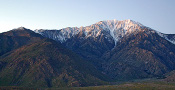
As we were heading back, dark clouds started moving in from the west. A storm was definitely due for the upcoming night. We got back to the trailhead and headed back towards Cabazon. The moonlight reflected vividly off of Mt. San Jacinto, which was showing off its gleaming coat of snow as we drove through Gorgonio pass. We parted with Pat, who was heading home to spend time with her husband. Tommey and I checked the forecasts for Cardinal Mountain. The weather window we had hoped for had now closed up from 2 days to 1. And even the sunny day was showing high winds. We decided to drop Cardinal and climb Mt. Charleston via the south loop instead. We gathered our stuff and began the 300 mile drive to Mt. Charleston, which we would begin climbing the next morning.