The New (for 2012) Whisperlite Universal

Southern California and far-away places. Hiking, wildlife, cycling etc.

The New (for 2012) Whisperlite Universal

Postby Hikin_Jim » Sun Sep 04, 2011 6:37 pm

I've been a little scarce on the forum lately. :( Been busy dealing with bugs (ugh!), and I've been working on a little "project". :)

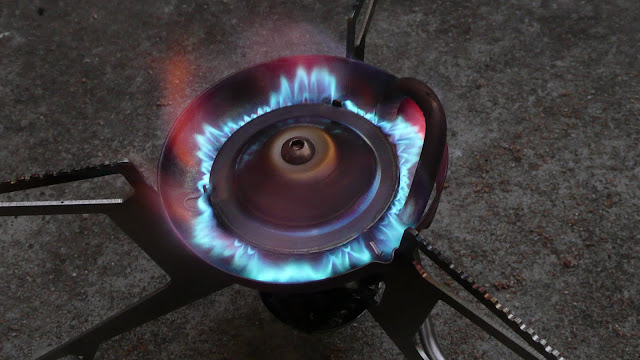
I'm evaluating the new MSR Whisperlite Univeral, which is set for public release in 2012. The Whisperlite Universal will do anything the old Whisperlite Classic or Whisperlite Internationale will do AND the Universal will burn canister gas. I've only run a few tests as of now, but I like what I see so far. I haven't finished my review, but I do have some videos of the new stove posted on my blog: MSR Whisperlite Universal -- First Videos, Detailed Photos

Here is a photo of the W'Lite Universal running on canister gas:
Image

HJ
Backpacking stove reviews and information:  Adventures In Stoving
Personal hiking blog: Hikin' Jim's Blog
User avatar
Hikin_Jim
 
Posts: 4958
Joined: Mon Oct 30, 2006 9:12 pm
Location: Orange County, CA

Postby Florian » Sun Sep 04, 2011 7:45 pm

Hi Jim. Love your stove reviews. My next stove will be either white gas or kerosene. I hate buying canisters. So wasteful. I actually like the smell of kerosene so i'm thinking i might go that way for something different.

Does the stove come with all 3 jets?

-Florian
User avatar
Florian
 
Posts: 1439
Joined: Sat May 16, 2009 4:49 pm
Location: Palm Springs

Postby Hikin_Jim » Sun Sep 04, 2011 8:07 pm

Hi, Florian,

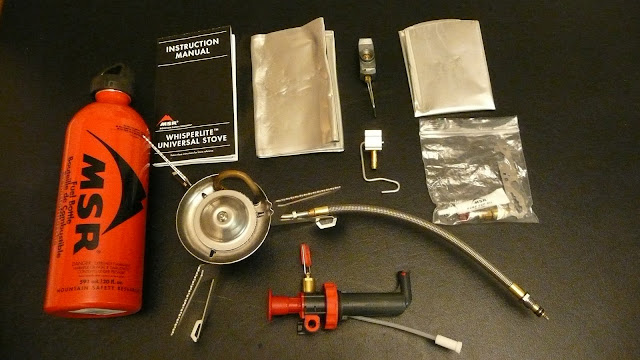
Yes, the stove comes with all three jets as well as both adapters (gas and liquid fuel).

Basically, the stove comes with everything you see in this photo except the bottle which is sold separately. Not shown in the photo is the stuff sack and a small stand that will hold the gas canister upside down for cold weather use.
Image

HJ
Backpacking stove reviews and information:  Adventures In Stoving
Personal hiking blog: Hikin' Jim's Blog
User avatar
Hikin_Jim
 
Posts: 4958
Joined: Mon Oct 30, 2006 9:12 pm
Location: Orange County, CA

Postby HH8 » Mon Sep 05, 2011 7:59 am

Hikin_Jim wrote:a small stand that will hold the gas canister upside down for cold weather use.HJ


Doesn't it normally lie on its side? I thought the pressurization feeds gas through the line, not liquid. How would upside down help in cold weather?
HH8
 
Posts: 529
Joined: Wed Aug 10, 2011 8:30 am
Location: San Diego

Postby phydeux » Mon Sep 05, 2011 9:45 am

I've seen some video on running a canister stove inverted (someone who climber Broad Peak?). Kind of curious about this, but how fast would the stove burn through a canister of isobutane if it was inverted for liquid flow, and is there any limitation on how long you can run it inverted without damaging the stove or having it fail? Seems like it would burn through a canister pretty quickly, and I'd also think it would be prone to flare-ups when inverted, and catastrophic failure if inverted for a long time.

I'm thinknig this stove has some compromises, too, like a desire to limit your equipment purchases (no one here does that, do they? :wink: ). Seems to me that if you wanted to get the high heat output of a white gas stove, why not just use a white gas stove (such as melting snow in winter)?, and use the more-costly-per-BTU canisters stoves for short summer trips where you desire convienience and ease of use (such as boiling water). YMMV.
3 of the 5 voices in my head are telling me to "Go for it!"
User avatar
phydeux
 
Posts: 348
Joined: Sat May 13, 2006 5:32 pm
Location: Orange County, CA.

Postby Hikin_Jim » Mon Sep 05, 2011 6:35 pm

HH8 wrote:Doesn't it normally lie on its side?
First, let me be clear here. I'm talking about using the Whisperlite Universal with a canister of gas, typically some blend of one more of the following: butane, isobutane, and propane. I am not talking about using the MSR Whiperlite Universal with a fuel bottle that contains "white" gasoline (e.g. Coleman Fuel) or kerosene. The W'lite Universal can operate with either a gas canister or a fuel bottle, but in this case I'm speaking specifically about canister gas.

Canister gas stoves normally operate with the canister upright. For example, here is a photo of an MSR Windpro with the canister upright.
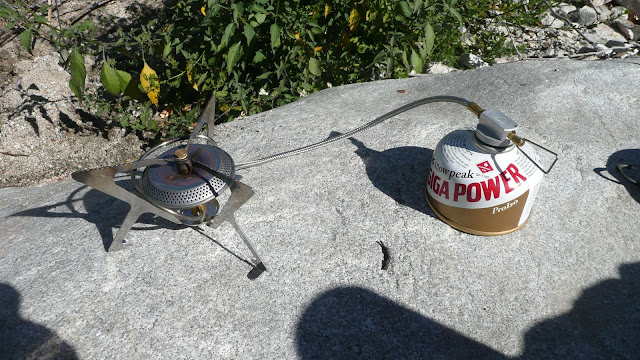
Image

For cold weather, the canister can be inverted (turned upside down). Here is a photo of the same MSR Windpro with the canister inverted.
Image

HH8 wrote: I thought the pressurization feeds gas through the line, not liquid.

You are correct. Normally, the pressure inside the canister of gas feeds a vapor down the line. This is referred to to as vapor feed mode. However, next time you have a canister of gas handy, shake it. That sloshing sound you hear? That's a liquid. Yes, at room temperature and pressure, the contents of that canister would be a gas, but inside the canister there's so much pressure that the gas liquefies. Now in normal (upright) operation, a vapor is drawn off the top. However, turn the canister over and now the canister's opening is on the bottom. The pressure in the canister now forces a liquid out the bottom of the canister. This liquid, sometimes referred to as LPG (liquefied petroleum gas), is what goes down the fuel when the canister is turned upside down.

HH8 wrote:How would upside down help in cold weather?
OK, so you've got this liquid in your canister. Gas stoves burn vapor not liquid. How do we turn that liquid into a gas? Basically by heat. In normal weather conditions (above freezing generally), this is no big deal, but it's in cold weather that gas stoves struggle. When we turn the canister upside down, liquefied gas is forced down the fuel line through this loop:

Image

That loop juts into the flame. The flame provides all the heat we need, and we can cook merrily along in weather where normally that liquefied gas would just sit there.

OK, so that was a long winded explanation, but basically the summary is that by turning the canister upside down, we use the heat of the flame to vaporize the fuel instead of the surrounding air temperature. In normal temperatures this doesn't matter, but if the air temperature is below the vaporization point of your fuel, then the liquefied gas will just sit there, and you've got a dead stove.

Hope that makes sense,


HJ
Backpacking stove reviews and information:  Adventures In Stoving
Personal hiking blog: Hikin' Jim's Blog
User avatar
Hikin_Jim
 
Posts: 4958
Joined: Mon Oct 30, 2006 9:12 pm
Location: Orange County, CA

Postby Hikin_Jim » Mon Sep 05, 2011 7:07 pm

phydeux wrote:how fast would the stove burn through a canister of isobutane if it was inverted for liquid flow?
When a stove is run on *full blast*, you will run through a canister of gas at a faster rate with an inverted canister. However, it is the flame size that determines how much gas you're going to burn through per unit of time. Adjust the flame size via the valve so that the flame size with the canister inverted is the same as it was with the canister upright, and you will get no better and no worse fuel economy.

phydeux wrote: is there any limitation on how long you can run it inverted without damaging the stove or having it fail? Seems like it ... would be prone to flare-ups when inverted, and catastrophic failure if inverted for a long time.
There is no limitation to how long you can run a stove with the canister inverted, but there is a big "BUT" to that. That "but" is that you must have a pre-heat loop (generator) on the stove.

Take a look at this photo.
Image
Do you see that tube arcing through the flame? That's the fuel line, and the portion that passes through the flame is known as a pre-heat loop or generator. If your remote canister stove does not have a pre-heat loop, it could be very dangerous to invert the canister. That flaring that you speak of more than likely will happen, and it could be entirely unpleasant (at least) and even dangerous. There are a couple of stoves that don't have a pre-heat loop, the Primus Omnifuel for example, that are safe to operate in inverted mode, but unless you know a specific stove is safe, stick to the rule: no preheat loop, no invert.

HJ
Backpacking stove reviews and information:  Adventures In Stoving
Personal hiking blog: Hikin' Jim's Blog
User avatar
Hikin_Jim
 
Posts: 4958
Joined: Mon Oct 30, 2006 9:12 pm
Location: Orange County, CA

Postby Hikin_Jim » Mon Sep 05, 2011 9:18 pm

I took the MSR Whisperlite Universal out to the East Fork of the San Gabriel River today for some field trials. The more I use it, the more I like it.

Image

HJ
Backpacking stove reviews and information:  Adventures In Stoving
Personal hiking blog: Hikin' Jim's Blog
User avatar
Hikin_Jim
 
Posts: 4958
Joined: Mon Oct 30, 2006 9:12 pm
Location: Orange County, CA


Return to Outdoors-Related Topics

Who is online

Users browsing this forum: Baidu [Spider], Bing [Bot] and 12 guests

cron