
Recently, a friend of mine who enjoys mountaineering asked the proverbial $64,000 question, "what's a good, light weight way to melt snow?" A fair question I might add, and perhaps one that I can actually shed some light on. So, for the next few weeks, my SOTW posts will focus on winter capable stoves. In that vein, this week's stove is the Coleman Xtreme, shown here in full fury.
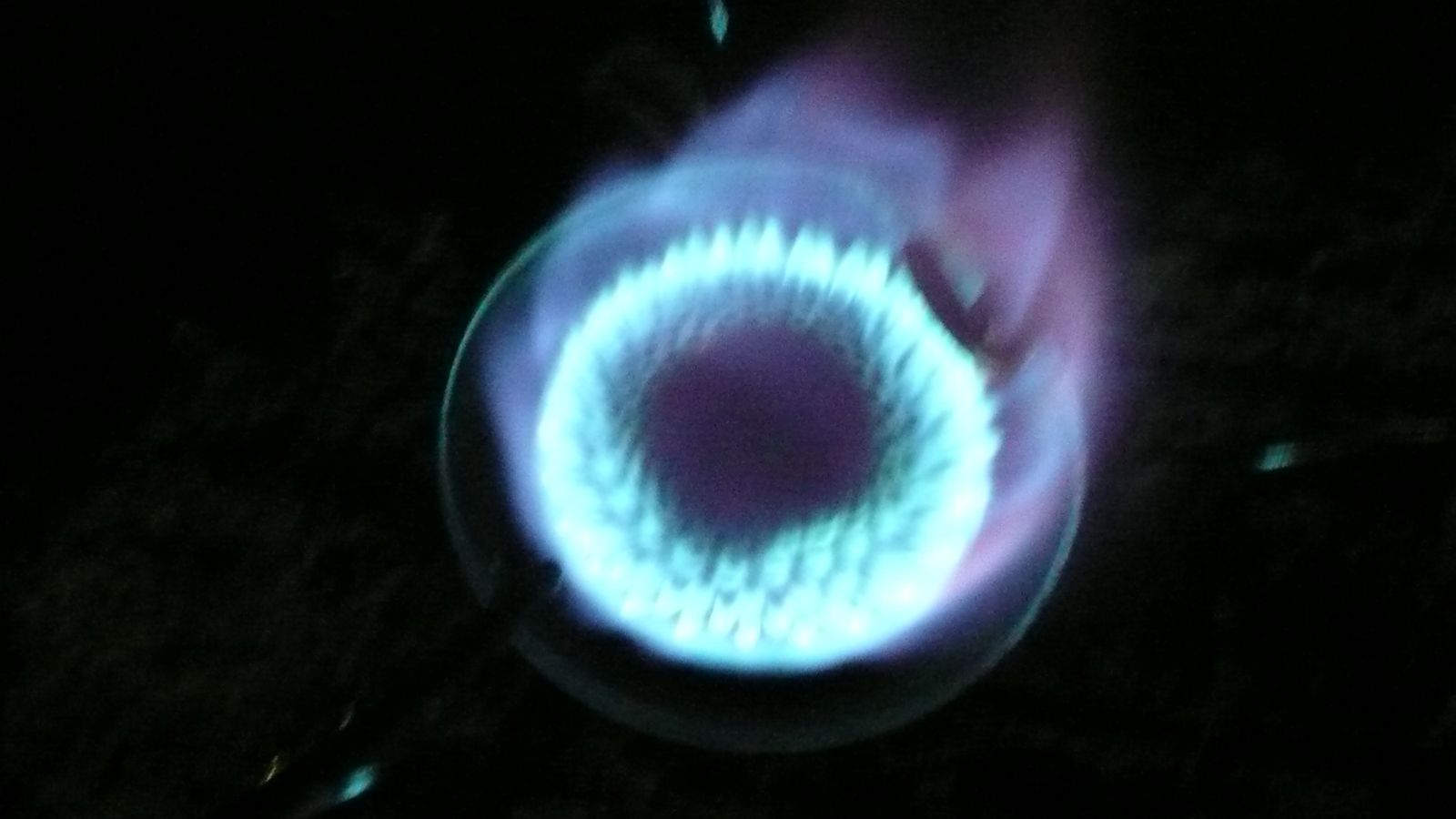
The Coleman Xtreme is a lightweight, winter capable liquid feed remote canister stove. Coleman rates it as operational down to about -4F (-20C). That's pretty dang good for a gassie. I've read posts on the net indicating that it will operate down as low as -10F (-23C), which is extremely good for a gas stove.
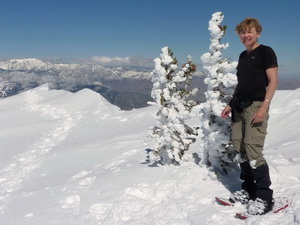
Let's take her for a whirl, shall we? For this week's post, we'll head over to the former Cobb Estate in Altadena, CA, now part of the Angeles National Forest. Here we'll catch the Sam Merrill Trail to Echo Mountain.

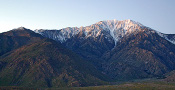
At the top, we have a commanding view of the San Gabriel Valley.

For tonight's stoving, we'll set up here on what remains of the front steps of Echo Mountain House, a hotel built in the 1800's that burned down years ago.
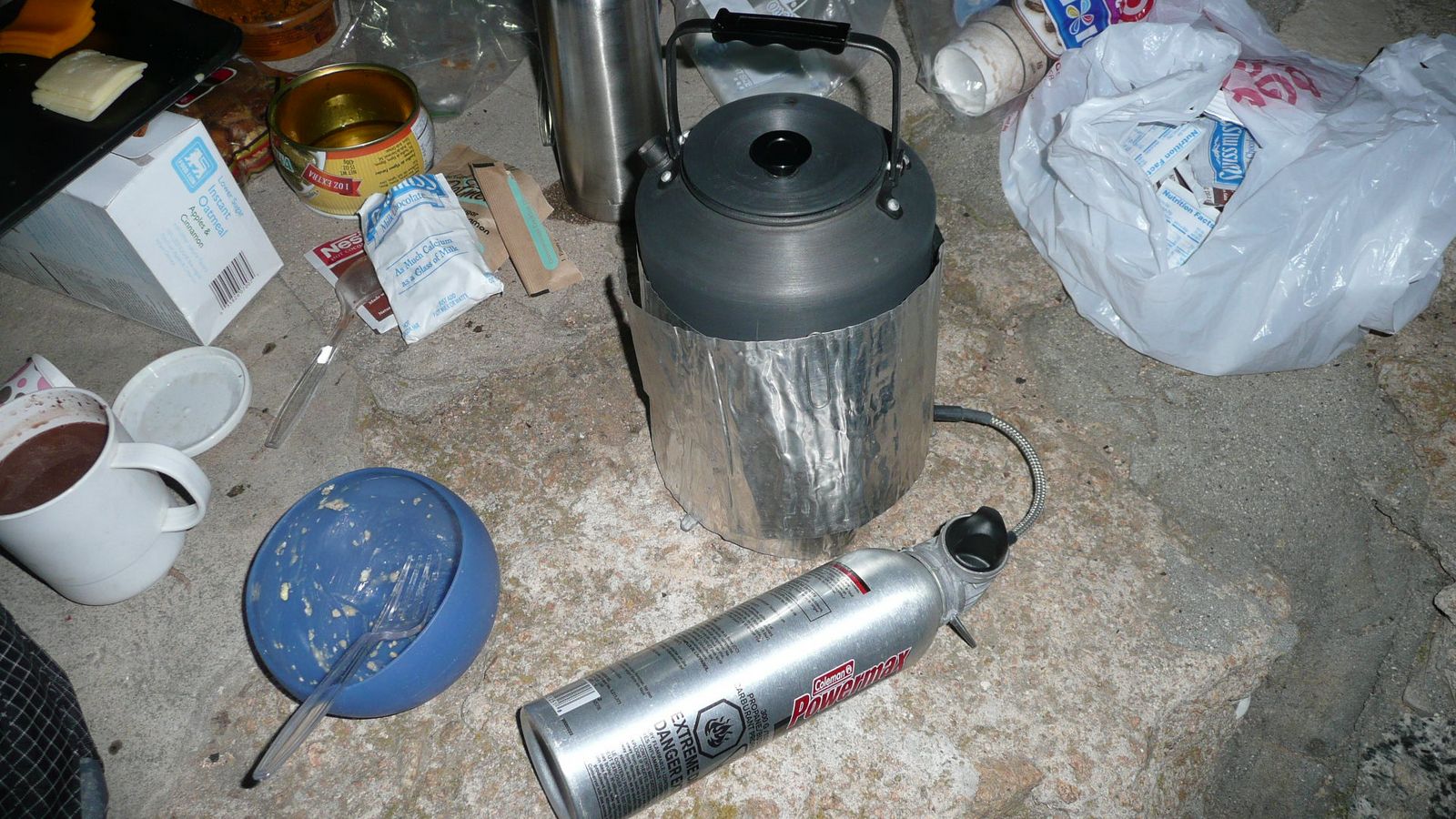
The pot's on to boil!
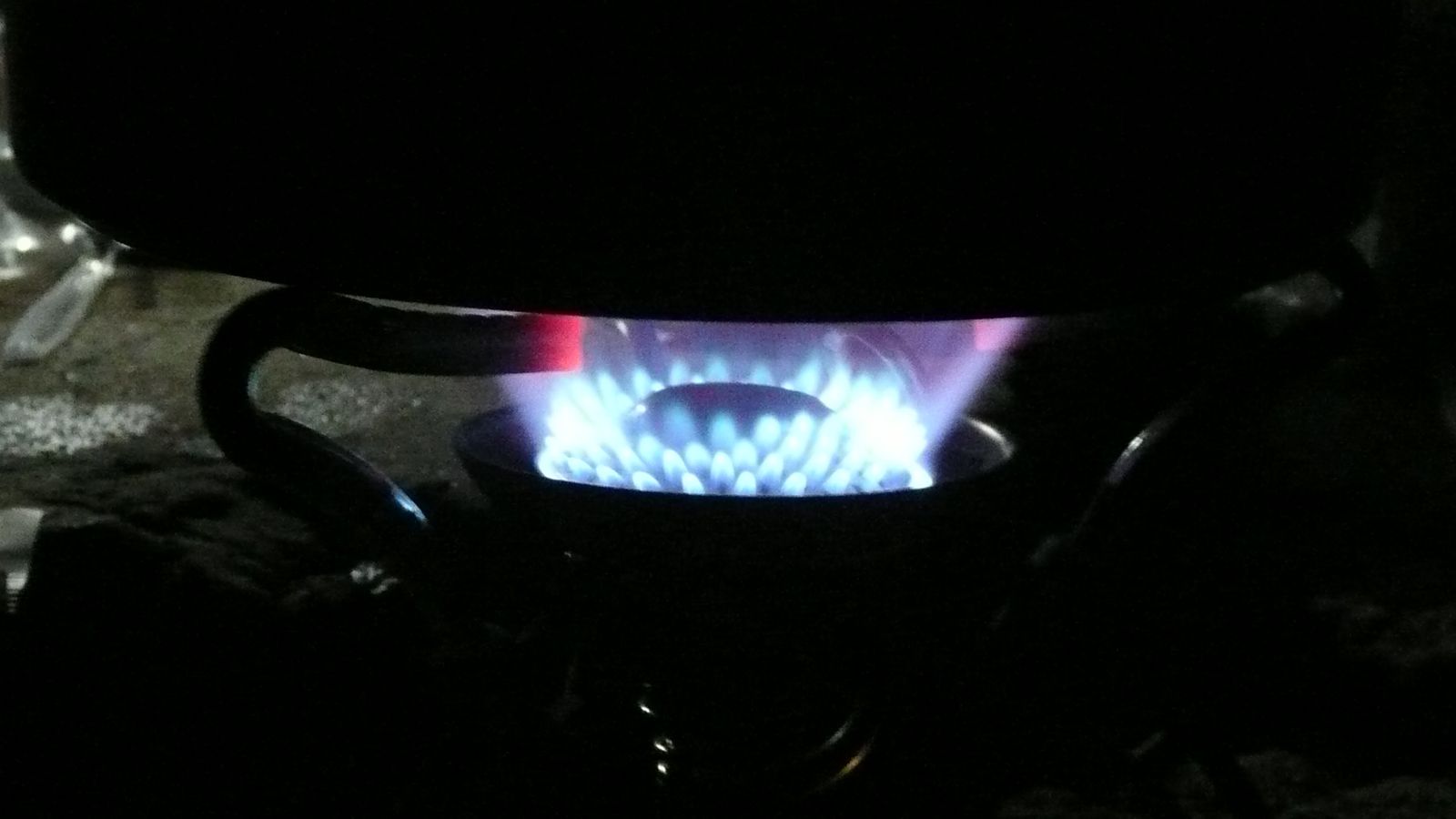
And in very short order, we've passed the tea test.
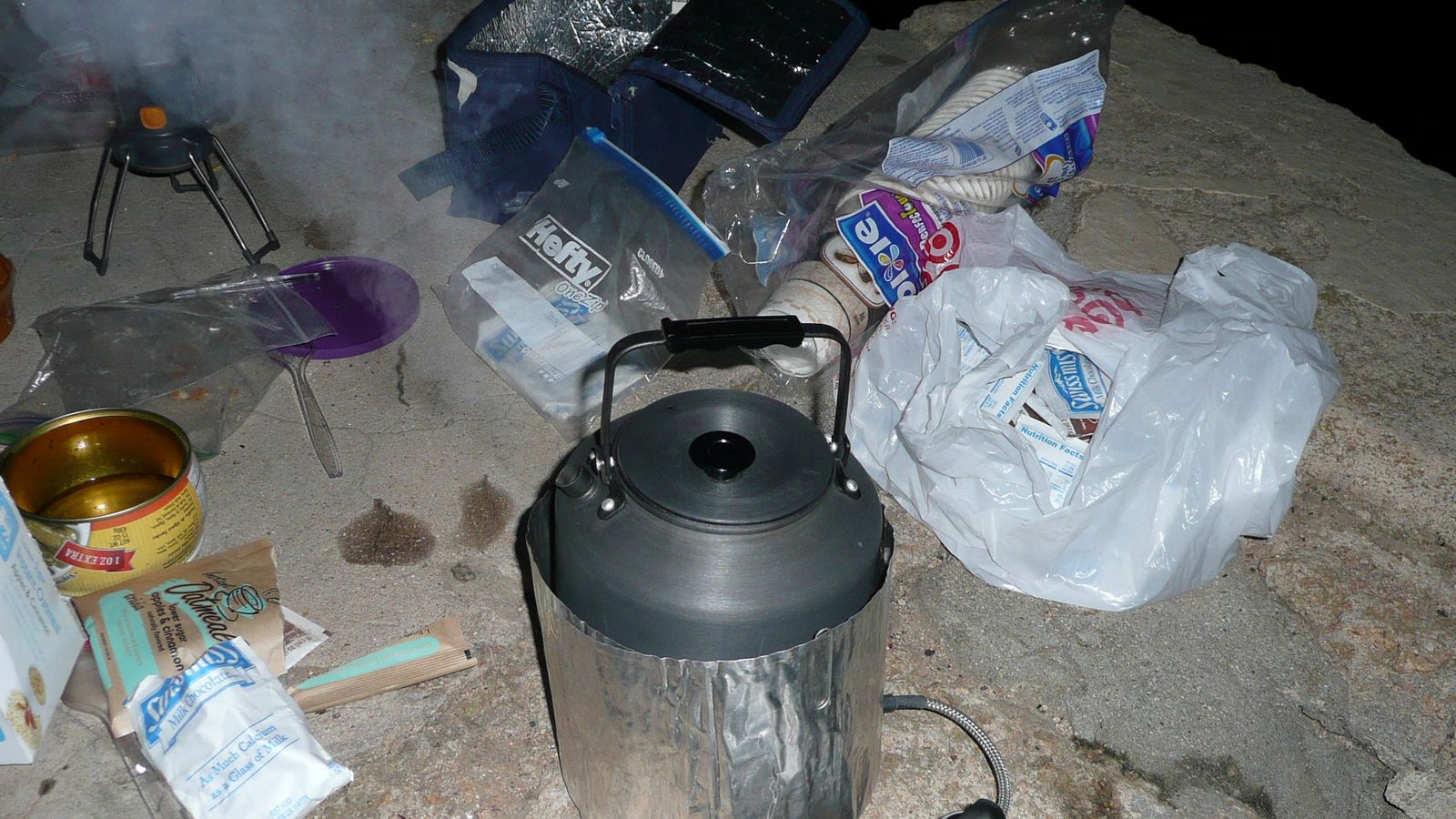
So, let's get to know a bit more about this week's stove. For those whose eyes glaze over with details, I'll include a summary at the bottom indicating the pros and cons of this stove for winter use.
Here's a shot of the Xtreme deployed and ready to go.

--WARNING, POTENTIALLY BORING TECHNICAL SECTION--
Before I go too much further, let me define some terms. First, there are generally two types of gas stoves: upright canister and remote canister (yes, there are plenty of exceptions). An upright canister stove is a stove where the burner mounts directly on top of the canister. Examples would include the MSR Pocket Rocket, the Optimus Crux, and the original Jetboil. A remote canister stove's burner is separate from the canister and draws gas via a fuel line. Examples would include the MSR Wind Pro, the MSR Rapid Fire, and the Primus Eta Power.
Second, there are two ways to deliver gas to the burner of a gas stove, vapor feed and liquid feed. In vapor feed mode, the fuel is delivered to the burner as a gas. In liquid feed mode, the fuel, though it would be a gas at room temperature and pressure, is delivered still under pressure as a liquid. You've heard the term LPG (Liquified Petroleum Gas)? That's exactly what this is. The gas is under such pressure that it liquifies into LPG and is delivered in that liquid state to the burner.
In terms of winter capability, why might it matter in what state the fuel is delivered to the burner? Well, canister fuel typically consists of some mix of the following three fuels: butane, isobutane, and propane. Each of these fuels vaporizes at a different temperature: butane at 31F (-0.5C), isobutane at 11F (-11.7C), and propane at -44F (-42.1C). If you deliver the fuel as a gas, it has to vaporize before it reaches the burner. If the outside temperature is lower than the vaporization point of your fuel, your fuel won't vaporize (it'll stay liquid), and your stove ceases to function. You can shake your canister and hear fuel sloshing around, but your stove is, quite literally, out of gas.
If on the other hand, you deliver the fuel as a liquid, then obviously there's no need to vaporize the fuel as it leaves the tank. Rather, the vaporization occurs at the burner where heat is available from the flame rather than from the surrounding air. In order to heat the fuel to the point of vaporization, typically there is a "pre heat loop" (aka "generator") in the fuel line that extends into the flame. Look at the very first photo in the first post of this thread. Note the dark object in the flame. This is the top of the loop. The fuel flows out of the canister, down the fuel line, and into the loop. The fuel is heated as it passes through the loop, and the liquid fuel turns to vapor, and the vapor exits via the burner and burns.
Hopefully I haven't lost anyone as I've explained this. It is a little bit complicated. If you didn't follow me completely, don't worry about it. The bottom line is that a liquid feed gas stove can be used in temperatures that are much lower than those in which a vapor feed gas stove can be used.
--END OF POTENTIALLY BORING TECHNICAL SECTION--
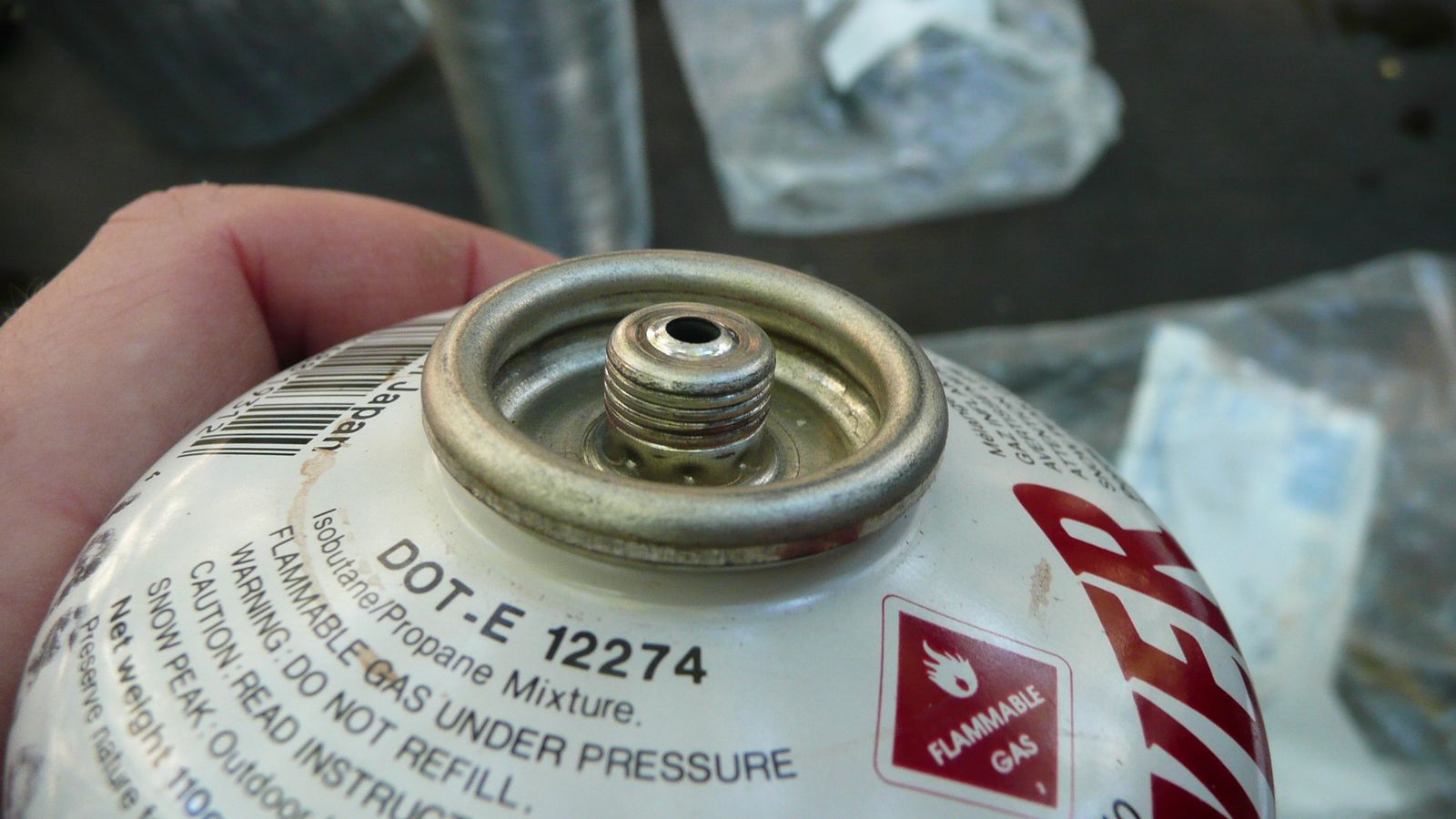
Now then, one thing you should be aware of with this stove is that it uses a special Powermax canister as shown in the photo below.

A Powermax canister has a hexagonal connector.

Note that this connector is completely different than the standard UNEF 7/16" threaded canisters (below).
The connector plugs into this assembly on the stove's valve:
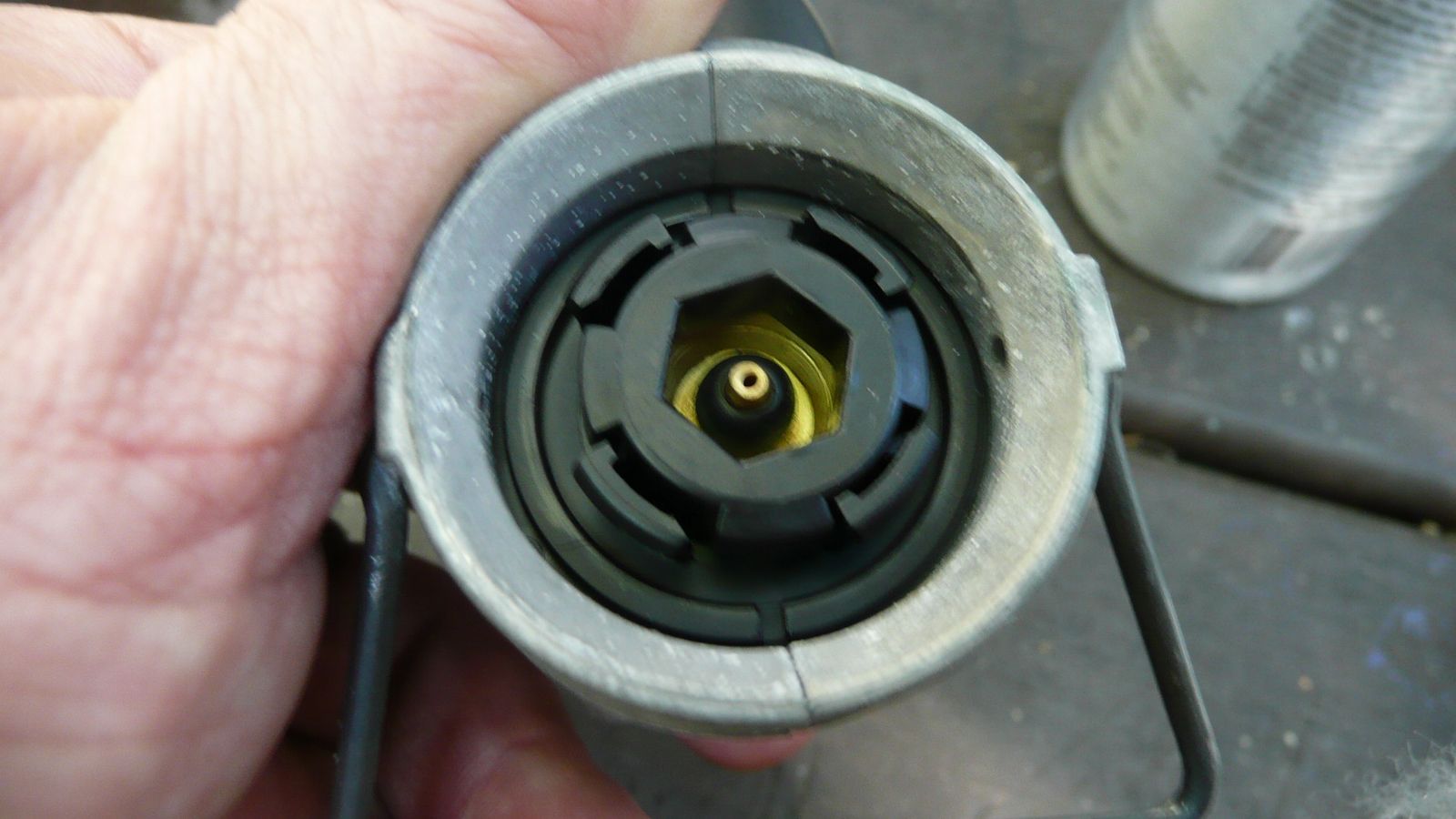
It's important to know that this stove uses different canisters because these Powermax canisters are generally less widely available than standard threaded canisters. In major metropolitan areas in the United States, it's generally not a problem. For example here in Los Angeles, Sports Authority, Big 5, REI, and Sport Chalet all carry the Powermax canisters. Elsewhere, such may not be the case. However, because of the stove's nature, it has a loyal following. One just has to make sure that the procurement of fuel is properly planned for.
These canisters do have several advantages:
1) They are made out of light aluminum instead of heavy steel. An empty 300g sized Powermax canister actually weighs less than an empty 100g sized standard threaded canister. You're lugging around a lot less of the dead weight of packaging. Packaging won't cook your supper. Gas will.
2) The canisters are side laying and are designed to feed fuel in liquid form with out the hassle of having to mess with fittings and having to prop up standard threaded canisters so that they'll stay inverted. If that last bit about inverted standard threaded canisters didn't make sense, I'll come to that in another week's post. Stay tuned.
3) The canisters, when depleted, can be punctured and recycled just as you would an aluminum can.
Recall that I said that this is a remote canister stove. Why might that be important? Well, if your canister is directly attached to your burner and you use a windscreen, the windscreen will reflect heat back to the canister. If your canister heats up to somewhere in the neighborhood of 200F (93C), KABOOM!, you no longer have a stove, you have an hand grenade, and let's just say that supper is now the least of your worries.
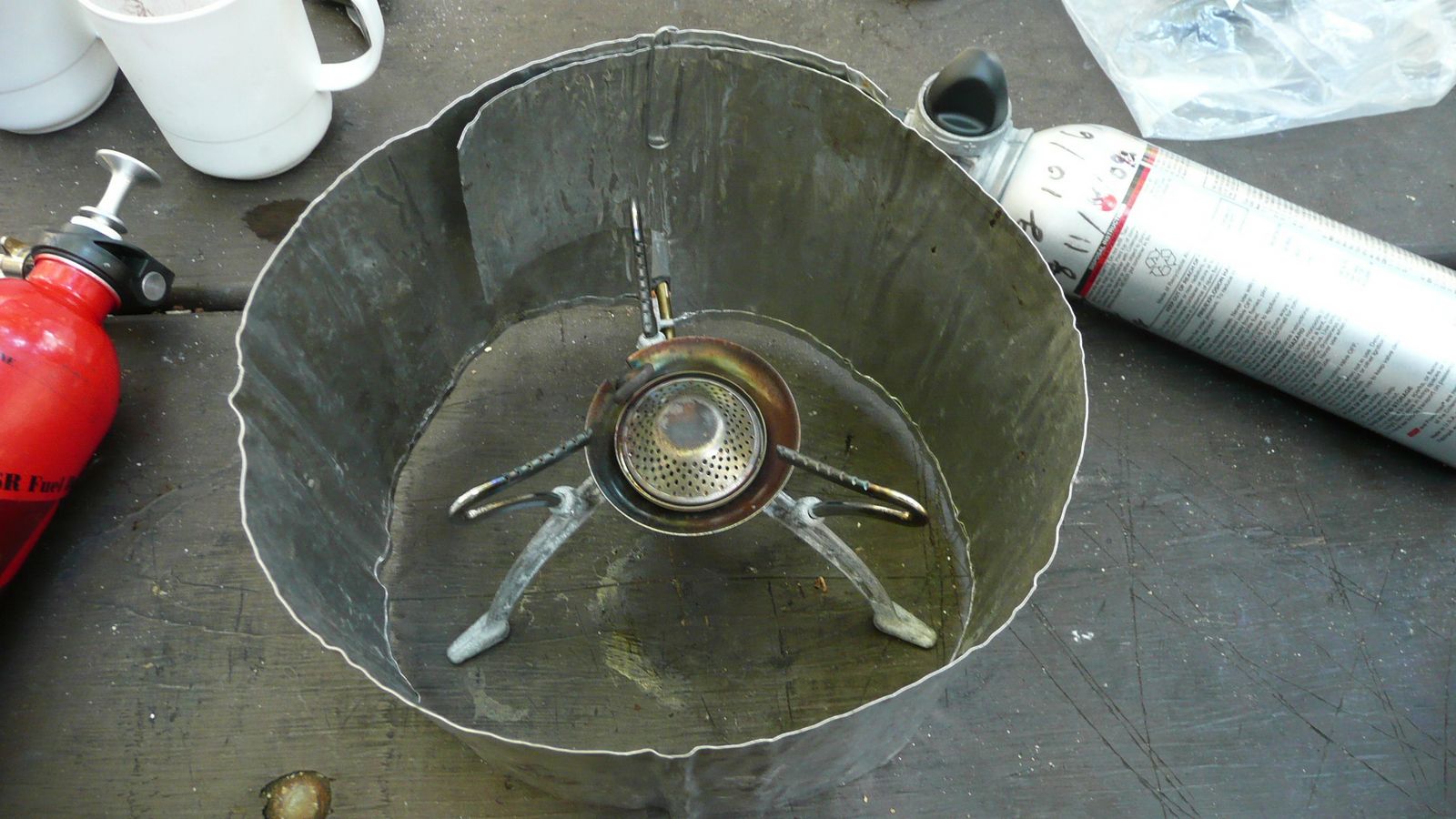
With a remote canister, the fuel is outside the windscreen. Problem solved; you may use a windscreen without fear, and trust me if you're cooking in cold temperatures (remember, we are talking about melting snow here), you want every advantage you can get. A windscreen not only blocks wind, but it traps heat, making your stove more efficient and keeping you hydrated. Recall that staying hydrated is critical if one is to avoid hypothermia.
An Xtreme with a windscreen (perfectly safe):
Regrettably, though the Xtreme is a fine stove, it never achieved acceptance with the public, and Coleman has discontinued it. Used Xtremes are still available. Coleman is still selling at last check other appliances that use the Powermax canister, and Coleman has publicly committed to continuing to manufacture the Powermax canister. Admittedly, this stove is a fairly specialized piece of equipment, and one has to go to a bit more trouble to procure and fuel it. I submit to you, though, that this stove because of its unique and superior design is worth that extra bit of trouble and is therefore worthy of your consideration as a winter capable stove.
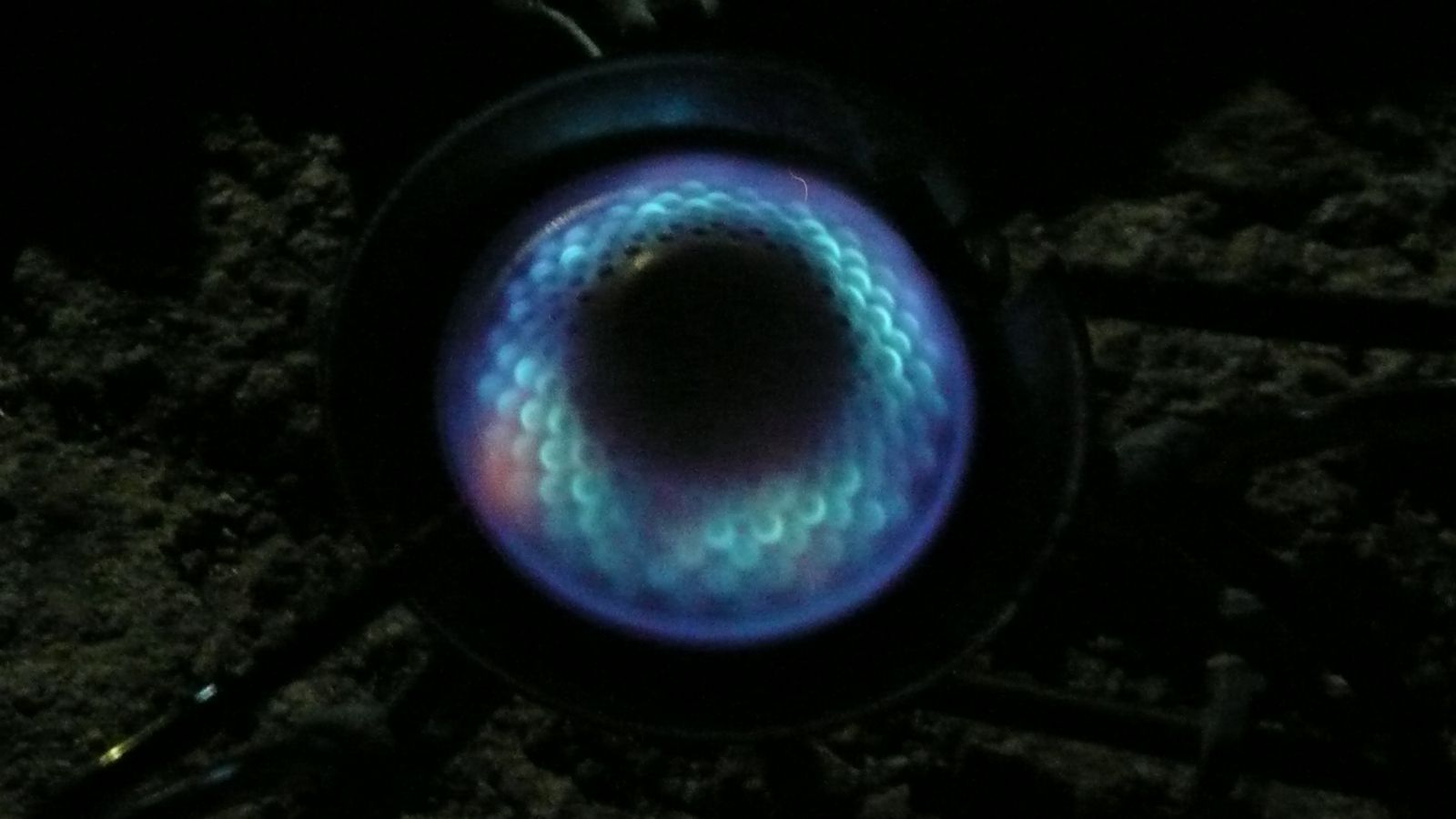
Let me leave you with one more shot of the Xtreme, here demonstrating her wonderful simmering ability.
This has been a most long winded post. I thank you for your patience, and I thank you for joining me in another adventure in stoving.
It's now time to head back down the mountain,
and I therefore bid you good night.
HJ
SUMMARY OF PROS AND CONS
Pros
-A relatively lightweight, stable, wind-resistant (with a screen), winter capable gas stove. The convenience of gas with good cold weather functionality. That's the real hallmark of this stove.
-For a remote canister stove, the Xtreme is lightweight at about 11oz (312g).
-Can use a windscreen safely and easily.
-Rated to -4F (-20C) and quite possibly good down to temps of -10F (-23C).
-Lightweight, easy to use canisters.
-Simmers well
-Quite powerful.
-Fuel is generally less expensive than standard threaded canisters.
-Stable, can handle larger pots than upright canister stoves (you need to be able to handle a bigger pot for snow melting)
Cons
-Discontinued. A used stove must be located*. Parts will eventually become hard to find.
-Powermax fuel is less widely distributed. This will be a problem in some areas and no trouble at all in others.
HJ
*Note: The three legged Xtreme has a four legged sister, the Xpert. Xperts for whatever reason seem to be easier to come by. If you can't find an Xtreme, you may be able to find an Xpert. Xperts typically are less expensive than the Xtreme, but they do weigh a couple of ounces more.