Forgotten Byways of the SGW

Southern California and far-away places. Hiking, wildlife, cycling etc.

Forgotten Byways of the SGW

Postby Hikin_Jim » Fri Sep 24, 2010 3:08 pm

I don't get out like I used to what with being married and having a child and all. Not that I'm complaining mind you. Just saying.

But last Friday I got one of those now rare opportunities in my life: an entire day free to do nothing but go hiking in the San Gorgonio Wilderness. Whoopie! :)

I haven't been on the old Lodgepole Trail for years and years, so I thought I'd give it a shot. What's that? You haven't heard of the old Lodgepole Trail? Well, you're not alone. It's one of the forgotten byways of the SGW.

Where is it? First clue: Look at John Robinson's Trails of the San Bernardinos. Look at his directions for Mine Shaft Flats and Big Tree. The book says to go to Mine Shaft Saddle and to go straight from the saddle. What? Straight? Going straight takes you over the edge right into the brush. Could John "the man" Robinson be wrong? Hardly. It's just that in the revisions of the book, something fell through the cracks. Robinson's directions are correct; they're just for a different time, a time when the main route went not through Trail Flats but Lodgepole Spring and Lodgepole Sadddle. Lodgepole Saddle is the saddle immediately NE from Mine Shaft Saddle. Regrettably, the old Lodgepole Trail has long been unmaintained and is really now more of memory than a trail.

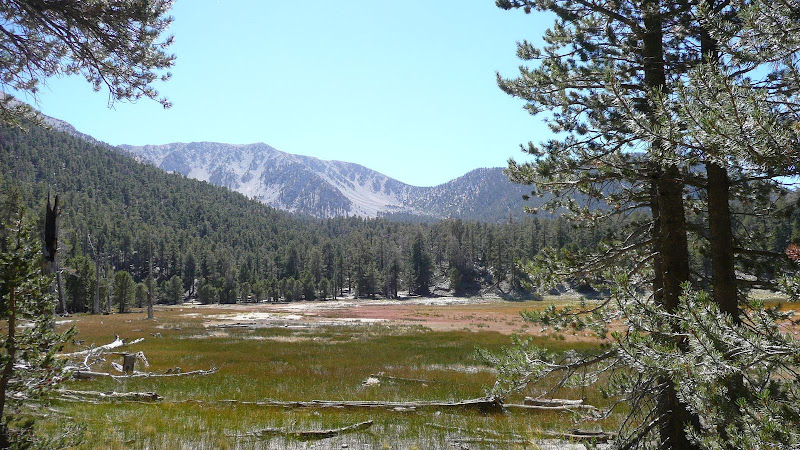
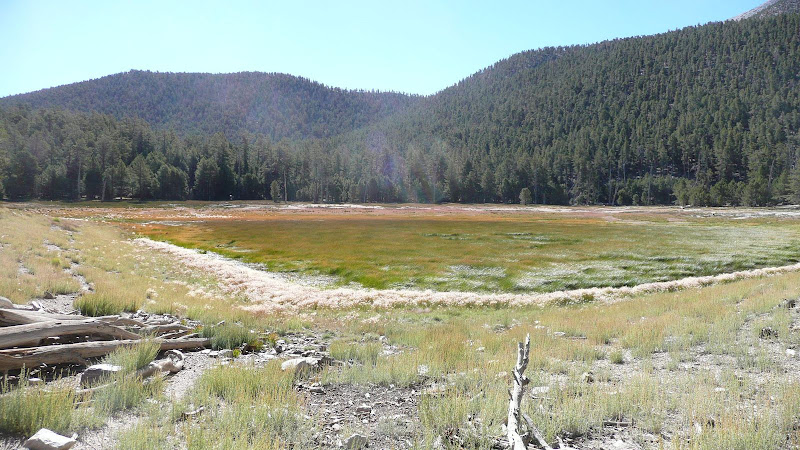
Well, let's get started on our expedition to find the trail, shall we? First, let's get to our jumping off point, Dry Lake, or, more accurately for 9/17/2010, Dry Lake Marsh.
Image

Now, when sniffing out old trails, it's almost always easier to do so in the down hill direction, so let's head up via the modern day route to Trail Flats first.
Image

From there, let's head up to Mine Shaft Saddle, and heck, while we're in the neighborhood, let's bag Zahniser Peak (10,056'), one of seventeen peaks over 10,000' in the SGW.

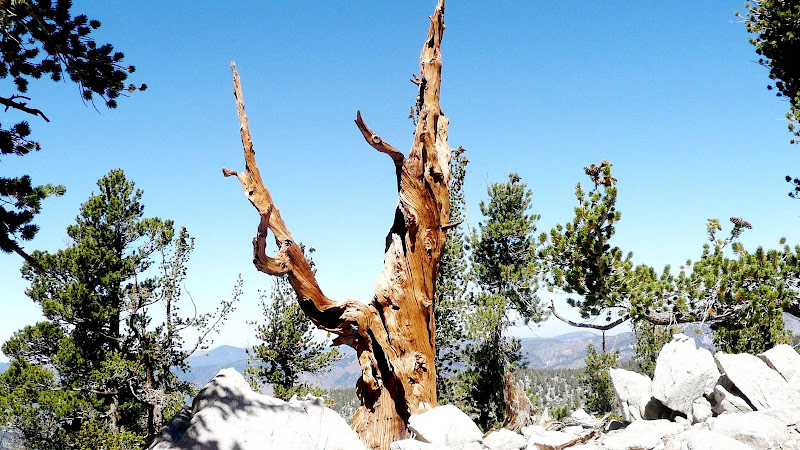
The summit of Zahniser Peak (10,056'). This old gnarled snag graces the summit.
Image

Dry Lake from the summit of Zahniser Peak. You can definitely see a few spots of open water.
Image

Lest you think that I haven't climbed much from the lake to the summit, here's a photo without the zoom. :)
Image

Another look at the beautiful old tree on the summit of Zahniser.
Image

From Zahniser, let's drop down to the start of our forgotten byway, Lodgepole Saddle, which is sometimes also called Zahniser-Lake Saddle.
Image

Now, let's find the start the trail. There it is. Not too tough.
Image

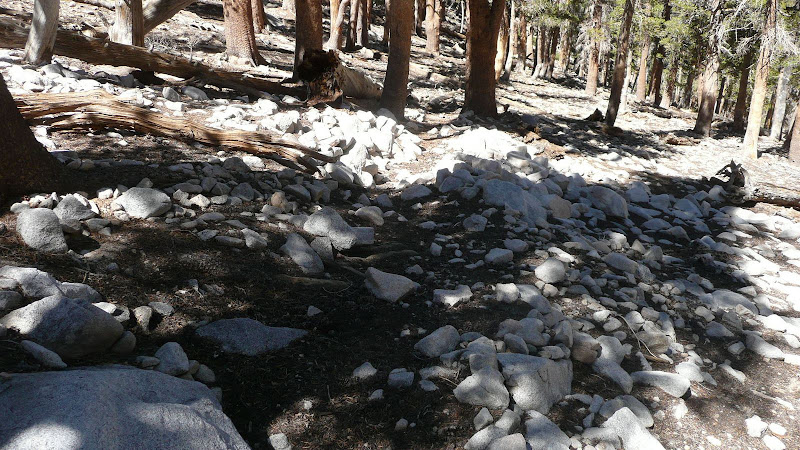
The trail is pretty easy to spot in many places even though it hasn't been maintained in years.
Image

Of course as in most old trails, it's not always so easy to spot the route. The thing to remember is that the old Lodgepole trail *always* stays above (west) of the drainage.

Sometimes you can find little clues, like the line of rocks here marking the downhill side of the trail.
Image

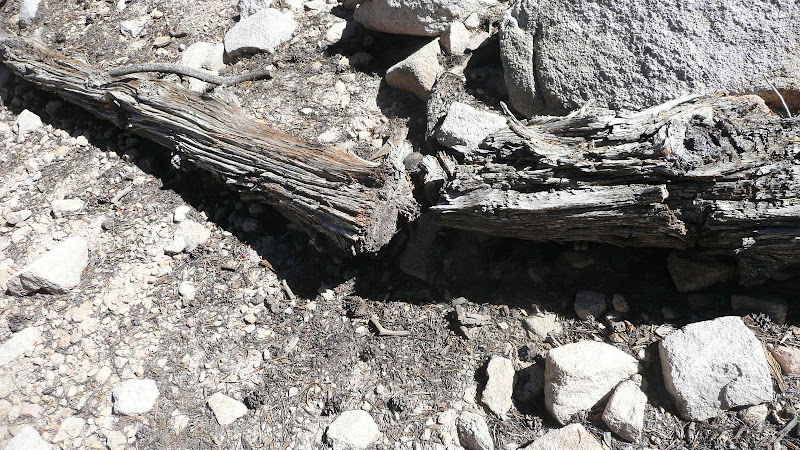
Or this old sawn log.
Image

Eventually though, you're going to get down into Lodgepole Flats. I've never been able to follow the trail through the flats. I basically follow the drainage at this point.
Image

All you need to do when going downhill is to follow the drainage until it meets the main drainage coming down from Fish Creek Saddle. When you meet the main drainage, proceed as though as though the drainage from Lodgepole Saddle continued, and you'll hit the Fish Creek Saddle Trail in maybe 50 yards. If you're going uphill, it's much trickier. You basically need to go up the drainage at about 170 degrees true.

In the photo below, I'm following the route (it's really not a trail at this point) through Lodgepole Flats.
Image

Here's a critical juncture. This is the confluence of the main drainage going up to Fish Creek Saddle and the somewhat lesser drainage going up to Lodgepole Saddle. One needs to follow the right hand drainage.
Image

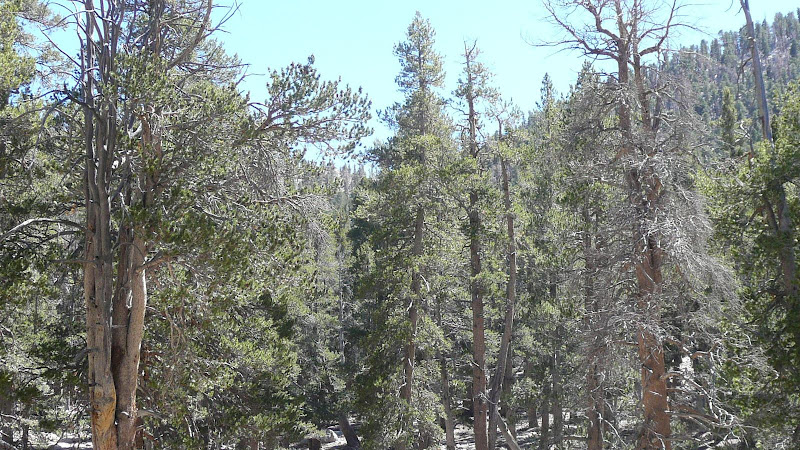
Again, coming down is no problem. However, if coming up the trail to Fish Creek Saddle from Lodgepole Spring, keeping looking to the right. A hundred or so yards past the upper edge of greenery surrounding the spring you should see an opening through the trees where a gap can be seen as shown in the photo. The gap is of course Lodgepole Saddle. Proceed here at approximately 175 true to the confluence shown in the previous photo. The confluence is perhaps 75 yards away from the trail. From the confluence head up the right hand drainage at about 170 true.
Image

Looking down trail from the point where the trail from Lodgepole Saddle hits the trail to Fish Creek Saddle, one can see the upper edge of the greenery surrounding Lodgepole Spring.
Image

This shark like rock marks the point at which you must leave the Fish Creek Saddle trail in order to get on the route/trail to Lodgepole Saddle.
Image

The route/trail from Lodgepole Saddle hits the Fish Creek Saddle trail just above Lodgepole Spring. Speaking of the spring, there were dozens and dozens of these little frogs around Lodgepole Spring.
Image

Image

Lodgepole Spring was flowing well.
Image

Below Lodgepole Springs, of course I once again reach the shores of Dry Lake.Image

Well, I hope you've enjoyed one of my little excursions down one of the many forgotten byways of the San Gorgonio Wilderness. Map of route.

For more photos, and for directions for finding the old Dry Lake Trail (yet another forgotten byway of the SGW), see my photos of the Old Lodgepole Trail and Old Dry Lake Trail.

Thanks for joining me on my journey through one of the best places in Southern California, the San Gorgonio Wilderness,

HJ
Last edited by Hikin_Jim on Fri Sep 24, 2010 8:40 pm, edited 1 time in total.
Backpacking stove reviews and information:  Adventures In Stoving
Personal hiking blog: Hikin' Jim's Blog
User avatar
Hikin_Jim
 
Posts: 4958
Joined: Mon Oct 30, 2006 9:12 pm
Location: Orange County, CA

Postby zippetydude » Fri Sep 24, 2010 4:35 pm

Hi Jim. Thanks for the tour. I believe there's an old trail that used to go up to either Dollar Lake or DLS, do you remember that one?

Incidentally, I'm not sure how the decision is made to let a trail fade, or to deliberately reroute the trail. Do you know what the process is?

z
User avatar
zippetydude
 
Posts: 2751
Joined: Tue May 09, 2006 5:40 am

Postby Hikin_Jim » Fri Sep 24, 2010 5:05 pm

zippetydude wrote:Hi Jim. Thanks for the tour. I believe there's an old trail that used to go up to either Dollar Lake or DLS, do you remember that one?

Incidentally, I'm not sure how the decision is made to let a trail fade, or to deliberately reroute the trail. Do you know what the process is?

z
Hi, Zip,

Yes, I do recall the old Dollar Lake Trail, both the section below the lake and the section above where you can go from the lake more directly to the saddle. My dad always took the old trail. He hated the "horse trail" as he called the Dollar Lake Trail of today. Back in the 60's, the old Dollar Lake Trail was as clear as a bell. Now, it's getting pretty tough to find.

The route looks something like this Acme Mapper Link. This is very approximate, sketched in from memory only. The lower section of the old trail leaves the modern day trail at about the point where the main trail makes a major switch back to the NW. The old trail then follows the drainage up a ways and then traverses over to Dollar Lake. I seem to recall that the old trail enters the Dollar Lake basin to the west of the little knob (near point "N") where it basically joins the modern day trail. The trail may not arc as much to the west as I've shown it. It's a great time saver if you can find it. If not, you can just use the general route it follows as a good cross country route. Heading straight up from point "A" to point "N" is pretty steep, but the route of the old trail avoids some of the worst of the steep terrain.

The upper section of the old Dollar Lake trail takes off from a little left (as one ascends) of the camping area at Dollar Lake. It kind of follows the little ridge south of the the camping area. I've shown it using points "O" through "U" in a highly approximate way. It's hard to pick up on the lower end. What I do is kind of start heading up that little ridge shown on the map until I get out of the area around camp with smaller rocks into the area with larger rocks where the trail is more obvious.

Coming down, it's actually reasonably easy to see the uphill end of the upper section of the old Dollar Lake trail, once you know where to look. You may even be surprised that you never noticed it before.

It saves some miles to use lower section of the old trail to head straight to Dollar Lake where one can get some water and then use the upper section to get back onto the main route to Dollar Lake Saddle.

I don't know for sure how they decide which trails to save and which trails to abandon, but it does look like they generally keep the pack trails and abandon the foot trails. The foot trails above and below Dollar Lake have been abandoned. The old Dry Lake foot trail has been abandoned. The old Lodgepole Saddle foot trail has been abandoned, but all of the pack trails in those areas are all still currently maintained trails.

HJ
Backpacking stove reviews and information:  Adventures In Stoving
Personal hiking blog: Hikin' Jim's Blog
User avatar
Hikin_Jim
 
Posts: 4958
Joined: Mon Oct 30, 2006 9:12 pm
Location: Orange County, CA

Postby Andy » Fri Sep 24, 2010 6:25 pm

Another great write-up Jim, thank you. I love that kind of route-finding stuff, how it makes you think "where would I put a switchback if I were building this trail or would it make sense to cross the creek here or down there....and there it is!"
I was thinking about Zip's comment on abandoning trails and it seems like it often comes down to popularity. A good example is Skyline. No one maintains it (ok, besides Florian) and it is kept in fairly good order, Meaning the trail is kept alive by just using it. So it's kind of a chicken or the egg scenario. Is a trail popular because an agency spends the time and money to maintain it, or visa verse? It seems that a true test of a "wanted or needed" trail would be to just let it be and see what happens.
Andy
 
Posts: 350
Joined: Mon Feb 04, 2008 4:21 pm
Location: Temecula

Postby Hikin_Jim » Sat Sep 25, 2010 7:03 pm

Andy wrote:Another great write-up Jim, thank you. I love that kind of route-finding stuff, how it makes you think "where would I put a switchback if I were building this trail or would it make sense to cross the creek here or down there....and there it is!"
Yeah, it's a lot of fun to sleuth out old routes or your own route. XC travel or travel on old trails is much more interesting to me than traveling the "normal" trails of an area. Take a look at the slide show I linked to. There's a lot of stuff shown there that most people never see even though I'm traveling very close to areas served by trails. People miss out on a lot of stuff that's right under their nose simply because they never get off the beaten path.

Andy wrote:I was thinking about Zip's comment on abandoning trails and it seems like it often comes down to popularity. A good example is Skyline. No one maintains it (ok, besides Florian) and it is kept in fairly good order, Meaning the trail is kept alive by just using it. So it's kind of a chicken or the egg scenario. Is a trail popular because an agency spends the time and money to maintain it, or visa verse? It seems that a true test of a "wanted or needed" trail would be to just let it be and see what happens.
I think that's a complex question. If a destination is popular enough, people will go to it even if there's no official trail (e.g. Skyline). There are other trails though, that, if not officially listed, will fade into obscurity, particularly if there are other ways to get to a particular destination. Some of the trails I've documented in the SGW are in that category. Others still, like the Sister Elsie Trail near me in Tujunga fade simply because they are out of the way and don't see enough use.

HJ
Backpacking stove reviews and information:  Adventures In Stoving
Personal hiking blog: Hikin' Jim's Blog
User avatar
Hikin_Jim
 
Posts: 4958
Joined: Mon Oct 30, 2006 9:12 pm
Location: Orange County, CA


Return to Outdoors-Related Topics

Who is online

Users browsing this forum: No registered users and 3 guests