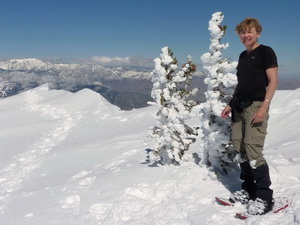
Howdy Ellen,
Sorry to hear of the Lost Spot.
I'll keep my eyes peeled for a large
X.
Perhaps some sticky-fingered losel (sic) will reveal his whereabouts via SPOT activation.
One can hope.
Taco and Simonov could rally a recovery team, no doubt? muha.
And to think, after you do a *Double* on Baldy, you are greeted by impolite inconsiderate mouth breathers onsite. grr.
As for the purple, please pardon these prosaic peregrinations, promised to tie in with outdoors/ hiking.Nature loves conservation and multi-usage of a good idea, and purple is no exception.
If anyone proffers snide comments on your purple duds, just tell them to please address you as Queen Ellen, of Royal Purple heritage.
Royal purple actually springboards from Tyrian purple. Early textiles had limited dyeing options. A vivid and colorfast purple dye could be extracted from Mediterranean sea snails ( Murex), but production quantities were limited, hence extremely expensive and valuable. The Powers That Be could afford it, and control supplies; such folk as Alexander the Great, Roman Emperors et alia were among the purple-togged luminaries.
A
snail's pace is my hiking pace, BTW.
(alter ego Energeezer Tortoise)
This and similar purple organic compounds are used by both snails and octopi as part of their defensive strategies.
And BTW the Aztecs also had similar snail-derived purple dyes, half a world away from Phoenecia.
You may have come across purple tinted waters at hot springs on your hikes. This is due to purple sulfur bacteria, which use anoxic photosynthetic pathways with sulfur/hydrogen sulfide instead of oxygen as the electron donor. (yawn, and who likes that smell, anyway? Well, it did give Hugo Chavez a jab at Bush...)
Of greater interest are the halobacteria and the connection with our eyesight.
You may have seen purple blooms in salt marshes as you fly into San Francisco Airport, or areas of the Great Salt Lake if you've flown to Utah for outdoor jaunts (not during winter, though). These bacteria
utilize bacteriorhodopsin for photosynthesis. That may ring a bell for you, as the compound is in the class which includes rhodopsin, or
visual purple.
The halobacteria use their rhodopsin to convert sunlight into stored /exchanged cellular energy. Our eyes use rhodopsin during transduction of light energy into informational content in our nervous system. Mother Nature sometimes likes to modify successful wheels rather than reinvent them entirely.
OK, one last connection ... just for fun...
Color codes for HTML vs. X11 can and do clash.
The X11 purple is called 'veronica.'
Veronica is also the name of a maneuver in modern bullfighting in which the bullfighter stands with feet planted, and with the cape draws the bull directly toward him. At the last moment, he pivots the feet 90 degrees to stand in profile, and sweeps the cape so that the bull *just misses him,* a very dangerous move. His calmness and grace represent fearlessness in the face of danger. (well, that's the cultural significance. I'm not a bullfighting fan, just a Hemingway fan, contextually. ;)
My old bud Paul Mehling of the Quintet of the Hot Club Of San Francisco penned a tune in '97 called, heh, "Veronica."
Django style Gypsy jazz.
Catchy.
(here's quick linkage to other QHCSF:
 http://www.hcsf.com/
http://youtu.be/GNuKGzxJJvU
http://www.hcsf.com/
http://youtu.be/GNuKGzxJJvU
So the next time someone on the trail makes a comment on your purple attire, just tell 'em to call you Queen Ellen, and to hike faster than a snail's pace, watch out for sulfur hot springs, enjoy the diversity of salt marshes and estuaries, be careful to avoid a slight mis-step which could have grave consequences, and be grateful to have the vision to enjoy all this beauty of Nature.
If our paths happen to cross on the trail... terrific!
kind regards,
arocknoid
PS:
I've never seen a purple hiker
I hope to one day see one;
though Queen Ellen is no hiking piker,
I'd rather see than be one.
(with apologies to YKW)
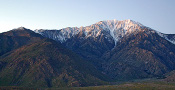


 Even the descent was nice -- just enough folks for a quick "Hi and have a good hike."

 .
.